Home › Advice › Louvered Pergola Buying Guide: What to Know Before You Sign a Contract
Louvered Pergola Buying Guide: What to Know Before You Sign a Contract
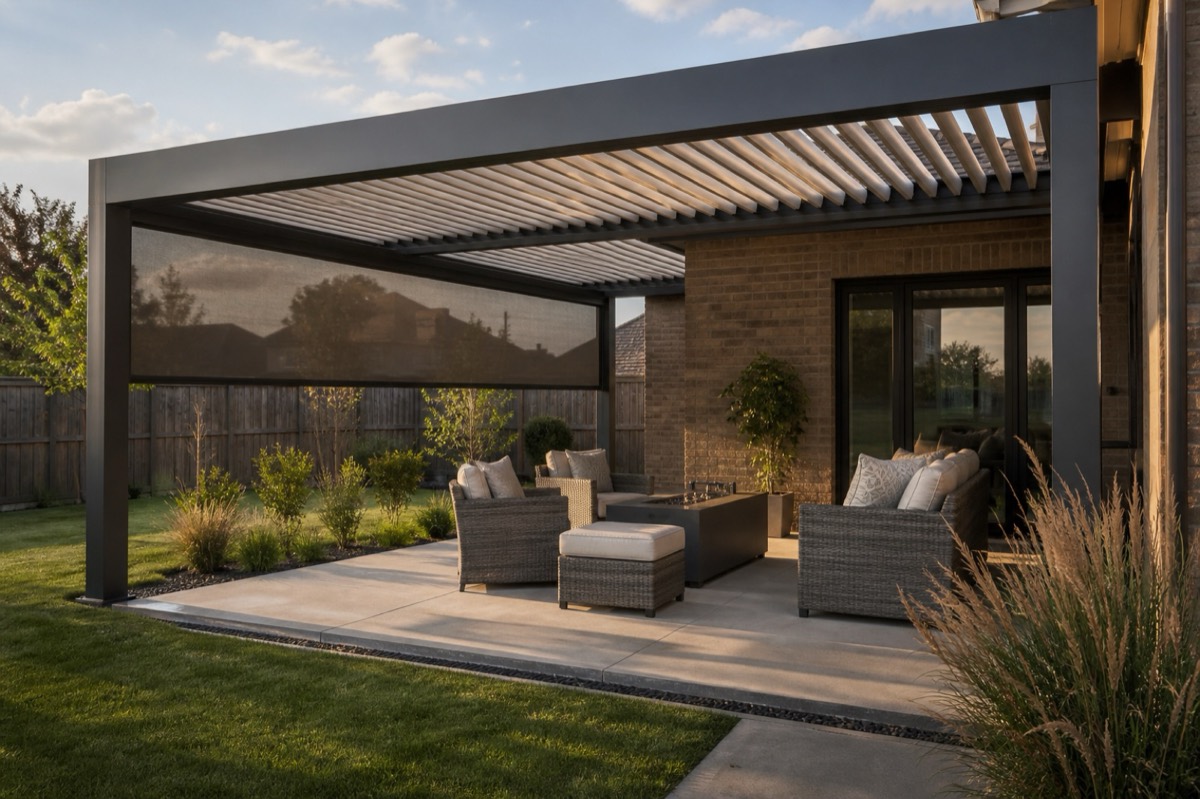
A louvered pergola is not a regular pergola with a fancy name. It is a motorized aluminum structure with a roof made of rotating slats — louvers — that open for sun and airflow, tilt for partial shade, and close to shed rain into a built-in gutter. Most systems run on a wall switch, remote, or app, and many add sensors that close the louvers automatically when rain starts.
Because these are engineered, motorized, permanently installed structures, buying one is closer to a small construction project than a patio furniture purchase. Here is what to sort out before you sign.
How the roof actually works
The louvers pivot along one axis, usually somewhere between fully open and fully closed. Open, you get sun and ventilation. Tilted, you get adjustable shade. Closed, the louvers interlock or overlap and rain runs into channels that feed an internal gutter, then down through a post to grade.
Two things to verify with any dealer:
- Where does the water go? Every closed-louver system needs a drainage path. Ask which post carries the downspout, where it discharges, and whether that spot drains away from your foundation. On attached units, ask how the connection to the house is flashed.
- What happens in a power outage? Some systems have manual overrides or battery backups; some do not. If the louvers are stuck open when a storm rolls in, you want to know your options in advance.
Attached vs freestanding
Attached units mount to the house on one side. They cost less in posts and footings, keep the covered area close to the back door, and can tie into existing patio structure. The tradeoffs: the attachment must be flashed and sealed correctly, the house wall has to carry part of the load, and permitting usually gets more scrutiny because you are modifying the structure.
Freestanding units stand on four or more posts with their own footings. They give you placement flexibility — over a pool deck, out in the yard — and avoid penetrating the house envelope. They typically need more concrete work and more engineering for lateral loads, since there is no wall bracing them.
Neither is universally better. Site conditions, soil, and how you plan to use the space should drive the choice, and a good contractor will walk you through why they recommend one over the other.
Aluminum vs wood-look
Almost every motorized louvered system is extruded aluminum. That is not a compromise — aluminum does not rot, warp, or feed termites, and powder-coated finishes hold up well outdoors. The "wood" question is really about appearance:
- Standard powder coat — solid colors, usually the most affordable and easiest to touch up.
- Wood-grain finishes — a textured or sublimated coating over aluminum that mimics cedar or teak. Costs more, looks warmer, and keeps aluminum's durability.
- Actual wood pergolas — fixed-roof or manually adjustable, not motorized louvered systems. If a salesperson offers a "wood louvered pergola" with motors, ask exactly what the moving parts are made of and how the wood is protected.
Ask for the finish warranty in writing, including what sun fading and coastal salt exposure do to coverage.
Wind: the Florida question
In Florida and other coastal areas, wind load is the engineering issue that separates serious products from cheap imports. Questions to ask every dealer:
- What wind speed is this structure engineered for, and can you show me the engineering documents for my county's requirements?
- Are the louvers designed to be left open, closed, or in a specific position during high wind?
- What do the footings look like for my soil, and who designs them?
Do not accept verbal assurances that a product is "hurricane-proof." Ask for the site-specific engineering that your permit will require anyway. If a dealer resists producing engineering paperwork, keep shopping.
What it costs
Louvered pergolas cost several times what a fixed-roof pergola or shade sail costs, and quotes vary widely by size, options, and site work. Two published reference points:
- Per HomeGuide's guide to StruXure pergola pricing, installed costs commonly run about $150 to $200 per square foot.
- StruXure's own published cost article puts a 12x16 pergola at around $45,000 installed as a representative example.
Your quote may land above or below those figures depending on brand, motors and sensors, screens, lighting, heaters, electrical runs, concrete work, and local labor. Get every quote itemized so you can compare structure, options, site work, and permit costs line by line.
Dealer or fabricator: who are you actually hiring?
Most name-brand systems are sold through authorized dealers who also install. Some local metal fabricators build their own louvered systems. Either can be fine, but they carry different risks:
- Brand dealers — ask how long they have carried the line, who services the motors after install, and whether the manufacturer's warranty depends on authorized installation.
- Independent fabricators — ask for engineering on their design, references for installs at least a few years old, and who supports the motors and controls if the shop closes.
Either way, verify the license before you sign. In Florida, look the contractor up at FL DBPR (myfloridalicense.com). In California, check CSLB (cslb.ca.gov). Texas has no state contractor license for this work, so lean harder on insurance certificates, references, and any voluntary credentials the company holds.
Permits are part of the deal
A motorized louvered pergola is a permanent structure with electrical components. Expect a building permit, often an electrical permit, and in wind-prone jurisdictions, sealed engineering drawings. The contractor should pull the permit, not you — an owner-pulled permit shifts liability onto you and is a common way unlicensed operators dodge accountability. Confirm in writing who pulls the permit and that final inspection happens before the last payment.
A short pre-signing checklist
- Itemized quote: structure, options, electrical, concrete, permits.
- Engineering documents matched to your county's wind requirements.
- Drainage plan showing where roof water discharges.
- License verified through the state lookup (FL DBPR, CA CSLB) or, in Texas, insurance and references in place of a license.
- Warranty terms in writing: structure, finish, motors, and labor, with who services each.
- Payment schedule tied to milestones, with final payment after inspection.
Take your time on this one. A louvered pergola done right is a decade-plus outdoor room. Done wrong, it is a five-figure structure with water pooling against your house and no one answering the service line.
Quick answers
- Do louvered pergolas keep rain out?
- When the louvers are closed, most systems channel rain into an integrated gutter and downspout built into the frame. They shed rain well, but manufacturers generally describe them as rain-shedding, not waterproof rooms. Ask how the specific model handles wind-driven rain and where the water exits.
- Do I need a permit for a louvered pergola?
- In most jurisdictions, yes. A louvered pergola is a permanent structure, often with electrical work for the motor, so it typically needs a building permit and sometimes an electrical permit. In Florida, wind-load engineering is usually part of the permit package. If a contractor suggests skipping the permit, treat that as a red flag.
- How much does a louvered pergola cost installed?
- Costs vary by size, brand, and site work. Per HomeGuide's guide to StruXure pergola pricing, installed costs commonly run about $150 to $200 per square foot, and StruXure's own published example puts a 12x16 unit around $45,000 installed. Get itemized quotes from at least two or three dealers.
Keep your home plan moving
Get the free Seasonal Home Maintenance Schedule
Month-by-month checklist for your state — roof, gutters, HVAC and more. Plus license-lapse alerts for contractors you're considering.
We don't sell your email address. See our privacy policy.
Sources
- How Much Does a StruXure Pergola Cost? — HomeGuide
- How Much Does a StruXure Pergola Cost? — StruXure